Multigrid Preconditioning: FMG vs GAMG
Underworld3 solvers are preconditioned with multigrid. There are two flavours, and choosing the right one — or letting the solver choose for you — makes a large difference to robustness and cost, especially on adapted or anisotropic meshes.
GAMG (algebraic multigrid) builds its coarse levels from the assembled operator’s connection graph. It is general and needs no mesh hierarchy, but it is sensitive to anisotropy: stretched cells (exactly what mesh adaptation produces) degrade the aggregates and the iteration count can cliff.
FMG (geometric Full Multigrid) builds its coarse levels from a genuine mesh refinement hierarchy. Because the hierarchy is geometric, it is inherently robust to anisotropy — the coarse spaces are correct regardless of how the operator is stretched.
The one-liner: build a mesh with refinement
Geometric multigrid needs a refinement hierarchy. Build one by passing
refinement=N to any mesh constructor:
import underworld3 as uw

# refinement=2 -> a 3-level geometric hierarchy (coarse -> medium -> fine)
mesh = uw.meshing.Annulus(radiusInner=0.5, radiusOuter=1.0,
                          cellSize=0.1, refinement=2)

stokes = uw.systems.Stokes(mesh)
# ... constitutive model, body force, boundary conditions ...
stokes.solve()        # velocity block is preconditioned with geometric FMG
That is the whole story for the common case. When the mesh carries a hierarchy, the solver automatically uses geometric Full Multigrid on the velocity block (for Stokes) or the top-level preconditioner (for scalar/vector solvers). When it does not, the solver falls back to GAMG. You do not need to set any PETSc options.
The preconditioner knob
Every Stokes / scalar / vector solver exposes a preconditioner property:
stokes.preconditioner = "auto"   # default: FMG if the mesh has a hierarchy, else GAMG
stokes.preconditioner = "fmg"    # force geometric multigrid (warns + falls back if no hierarchy)
stokes.preconditioner = "gamg"   # force algebraic multigrid (the historical default)
"mg" is accepted as an alias for "fmg".
Note
"auto" is conservative. It only ever adds geometric multigrid on top of an
untouched default — it never rewrites a preconditioner you configured yourself. If
you set pc_type directly through solver.petsc_options[...], or a solver applies
its own tuned options internally, "auto" leaves those settings alone.
What the FMG bundle actually sets
For reference (you should rarely need to set these by hand), selecting geometric
multigrid is equivalent to the following options on the relevant block
(fieldsplit_velocity_ for Stokes, top-level for scalar/vector):
pc_type                      = "mg"
pc_mg_type                   = "full"        # Full Multigrid (F-cycle)
pc_mg_galerkin               = "both"        # RAP coarse operators (see below)
mg_levels_ksp_type           = "chebyshev"
mg_levels_pc_type            = "sor"
mg_levels_ksp_max_it         = 4
mg_coarse_pc_type            = "lu"          # direct coarse solve
Why Galerkin coarse operators? Underworld3 does not install
residual/Jacobian callbacks on the coarse DMs, so the coarse operators must be
formed by Galerkin projection (\(R A P\)) from the fine operator rather than by
re-discretising on the coarse mesh. pc_mg_galerkin = both does this.
Hierarchy and mesh adaptation
This is the key reason to prefer FMG when you adapt:
The coordinate-deforming adaptation movers (the MMPDE mover /
follow_metric) preserve mesh topology. The refinement hierarchy survives them, so geometric multigrid keeps working as the mesh deforms — precisely where GAMG struggles with the resulting anisotropy.A true remesh (a topology change) collapses the hierarchy to a single level. In
"auto"mode the solver detects this and transparently reverts to GAMG on the next solve, so nothing breaks — you simply lose the geometric path until a hierarchy is available again.
Parallel coarse solve
The default coarse solver is a serial direct solve (mg_coarse_pc_type = "lu"),
which is the fast, simple choice in serial and for modest core counts. For large
parallel partitions, replicate or gather the (small) coarse grid instead:
# redundant: copy the coarse grid to every rank and solve it there
stokes.petsc_options["fieldsplit_velocity_mg_coarse_pc_type"] = "redundant"
stokes.petsc_options["fieldsplit_velocity_mg_coarse_redundant_pc_type"] = "lu"

# or telescope onto a sub-communicator for very large runs
# stokes.petsc_options["fieldsplit_velocity_mg_coarse_pc_type"] = "telescope"
Because "auto" does not overwrite options you set yourself, you can keep
preconditioner = "auto" and just override the coarse solver as above.
Benchmark: FMG vs GAMG on a deforming adaptive mesh
The payoff is clearest on an aggressively adapted mesh. The figure below is a
Stokes convection run (annulus, Ra = 10⁷, Δη = 10³, res 32, resolution-ratio
R = 8, mode-1, np = 5) whose mesh is continuously deformed by the MMPDE
coordinate mover, adapted every timestep. The geometric hierarchy (3 levels)
survives every step — topology is preserved — and both engines converge cleanly
(snes reason 3) throughout. FMG (PCVEL=gmg MG_TYPE=full) and GAMG
(PCVEL=amg) ran the identical adapted-mesh sequence over 50 steps.
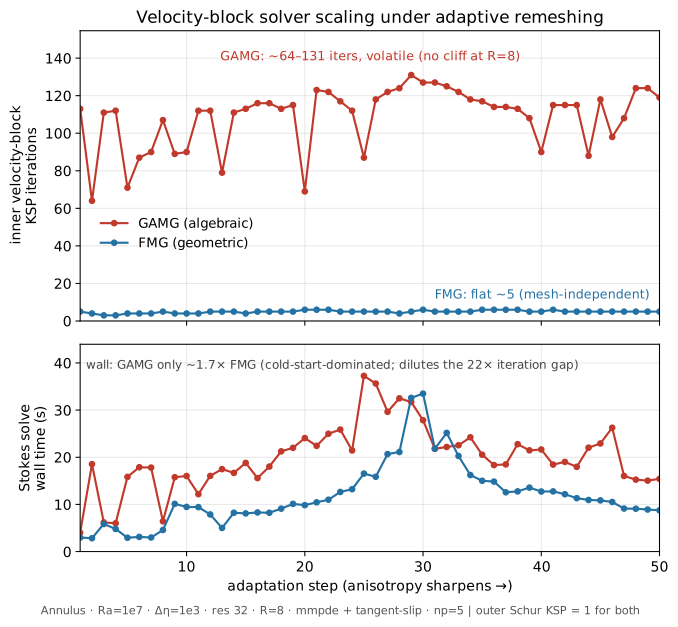
Velocity-block solver scaling under adaptive remeshing. Inner velocity-block KSP iterations (top) and Stokes-solve wall time (bottom) versus adaptation step. Geometric full multigrid (FMG) keeps a mesh-independent ≈ 5 inner iterations as the cells stretch, where algebraic multigrid (GAMG) runs a volatile ≈ 64–131 (≈ 23×) without cliffing at this anisotropy. The wall-clock gap is only ≈ 1.8×: each GAMG V-cycle is far cheaper than an FMG F-cycle, and the cold-start Stokes solve after each adapt (common to both) dominates the time. The outer Schur KSP converges in one iteration for both — the difference is entirely in the inner velocity block.
The metric that matters is the inner velocity-block KSP iteration count — the outer Schur KSP is one iteration for both engines, so the entire difference lives in this inner block:
FMG holds a mesh-independent ≈ 5 iterations (3–6) as the anisotropy sharpens — the geometric-MG signature.
GAMG runs a volatile ≈ 64–131 (median ≈ 114, so ≈ 23×) as the algebraic aggregates cope with the stretched cells. It does not cliff at R = 8 over these 50 steps, but it is unpredictable from step to step.
The wall-clock gap is only ≈ 1.8×, not 23×: a single GAMG V-cycle is far cheaper than an FMG F-cycle, and the cold-start Stokes solve after each adapt (common to both engines) dominates the per-step time. So the value of geometric FMG here is predictability and mesh-independence — properties that widen with problem size and multigrid depth — rather than a large raw speed-up. The iteration gap is also where GAMG eventually loses robustness on harder problems (higher anisotropy, more levels).
The per-step data is in
figures/bench_fmg_vs_gamg_velocity_ksp.csv;
the reproduction command and full provenance are in the companion note
figures/bench_fmg_vs_gamg_velocity_ksp.md.
When to use which
Situation |
Recommended |
|---|---|
Adapted / deformed / anisotropic meshes |
FMG (build with |
Uniform mesh, want mesh-independent iteration counts |
FMG |
No refinement hierarchy available / quick prototype |
GAMG (automatic fallback) |
Reproducing historical results exactly |
|
See also
Adaptive Mesh Refinement — the movers whose anisotropy FMG handles gracefully
Performance Optimization — profiling and scaling
docs/developer/design/solver-strategies-catalogue.md— the solver-strategy design notes (developer-facing)