Welcome to Underworld3
Computational Geodynamics Made Accessible
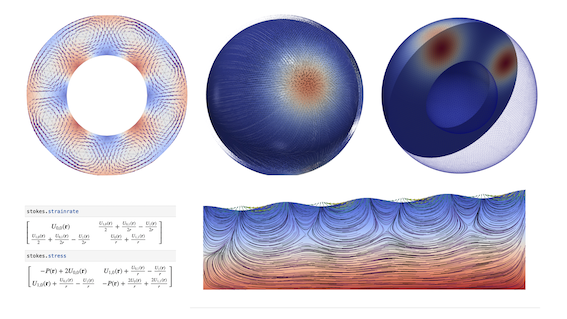
Underworld3 is a Python library for computational geodynamics, providing finite element modeling for Earth science research.
For new users
Learn Underworld3 fundamentals through interactive tutorials and hands-on examples.
Install and configure Underworld3
Create your first geodynamic model
Work through progressive tutorials
Understand meshes, variables, and solvers
For researchers
Master parallel computing, optimization, and complex physics for research-grade simulations.
Write parallel-safe code using UW3 API
Understand collective operations in PETSc
Optimize simulation performance
Implement complex rheologies
For contributors
Understand the architecture, implementation details, and contribute to Underworld3 development.
Architecture and design patterns
Create new solvers and features
Follow coding standards
Contribute effectively
About Underworld3
Underworld3 is a Python library for computational geodynamics, built on:
PETSc for scalable parallel finite element methods
SymPy for mathematical self-description
Particle-in-cell methods for Lagrangian tracking
Natural mathematical syntax for intuitive model development
Getting Help
Join community discussions
Found a typo or broken link? Click the speech bubble icon (💬) in the page footer to report it—the issue will be pre-filled with this page’s URL. You can also click the GitHub icon to browse the repository, or use “Edit on GitHub” (top right) to propose changes directly.
Try It Now
Launch interactive tutorials directly in your browser:
